


Source: Mercedes-Benz Classic Archive
Silver Arrow - naked skin made of aluminum
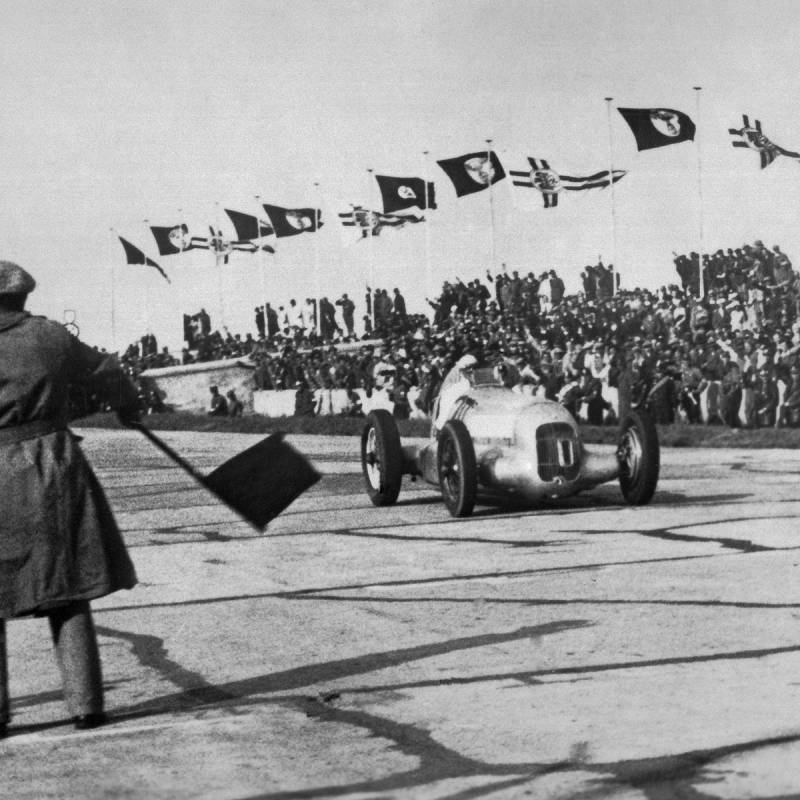
It is a simple idea that makes silver the color of racing success in 1934. It all begins on the eve of the Eifel race at the weighbridge at the Nürburgring. The regulations allowed a maximum weight of 750 kg for each vehicle. However, the brand new W 25 weighs one kilogram too much. But Alfred Neubauer, race director of the Mercedes-Benz team, has the white paint sanded off so that the pure aluminum bodywork sparkles silver. The next morning, Manfred von Brauchitsch climbs into the 750 kg light car and wins the race in the “Silver Arrow” with aplomb.
Source: Mercedes-Benz Classic Archive
Speed Ø 122.5 km/h
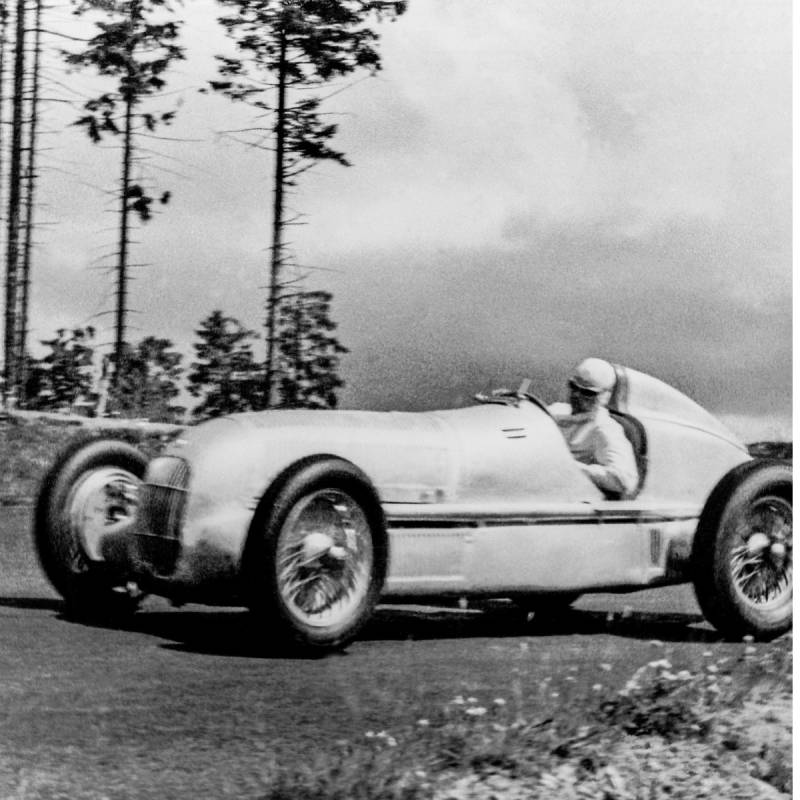
The W 25 is fast on the track, reaching top speeds of up to 300 km/h. But speed also counts in the pits. But speed also counts in the pits. That’s why the hood, which has many ventilation slots, has quick-release fasteners. They can be opened in just a few seconds without tools.
The W 25 was developed from 1933 as a classic front mid-engined racing car. It was further developed during its time in motorsport until 1936. It made its debut with a 3.4-liter inline eight-cylinder supercharged engine (M 25 A), which produced up to 260 kW (354 hp) at 5,800 rpm. The 4-liter M 25 B engine with up to 316 kW (430 hp) followed in the same year, 1934. The enormous output can also be seen in the exhibit in the Mercedes-Benz Museum.
Source: Mercedes-Benz Classic Archive
The beginning of a success story
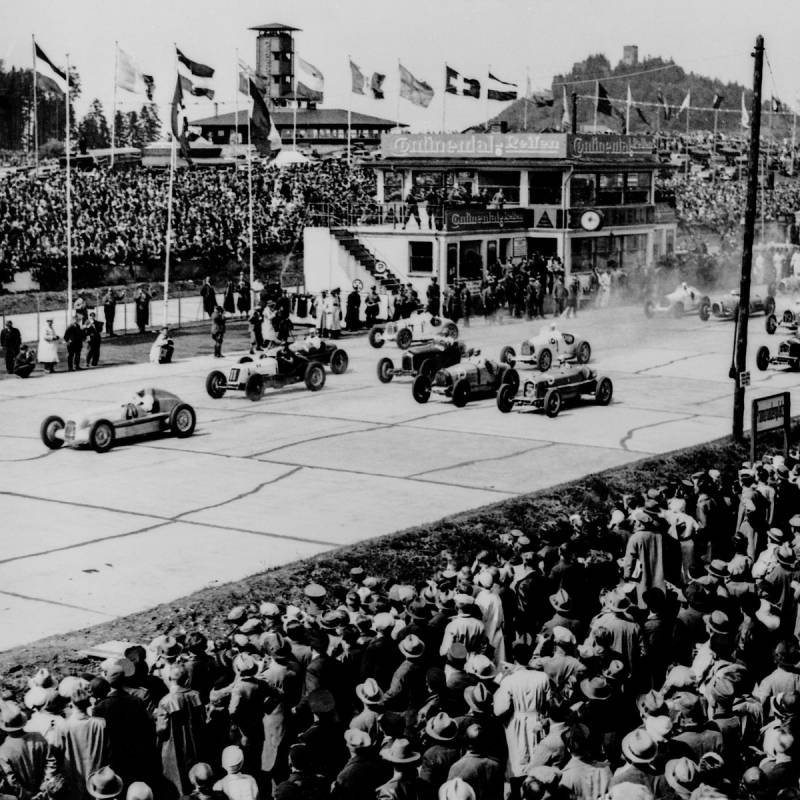
The W 25 was followed by the Silver Arrows of the 1930s and 1950s. Mercedes-Benz returned to Formula 1 as an engine supplier in 1994, and the brand has had its own works team again since 2010. Since 1934, the Silver Arrows have won three European Championships (Rudolf Caracciola in 1935, 1937 and 1938) and twelve Formula 1 World Championship drivers’ titles: Juan Manuel Fangio became world champion in 1954 and 1955, Mika Häkkinen in 1998 and 1999, Nico Rosberg in 2016, Lewis Hamilton won the championship in 2008, 2014 and 2015 as well as 2017 to 2020.
Technical data: Silver Arrow W 25
The W 25 was developed from 1933 as a classic front mid-engined racing car. It was further developed during its time in motorsport until 1936. It made its debut with a 3.4-liter inline eight-cylinder supercharged engine (M 25 A), which produced up to 260 kW (354 hp) at 5,800 rpm. The 4-liter M 25 B engine with up to 316 kW (430 hp) followed in the same year, 1934.
Eight-cylinder four-stroke in-line engine, 5 crankshaft bearings, 2 rising-flow carburetors (Mercedes-Benz),
2 overhead camshafts with spur gear drive, 4-valve technology,
1 Roots compressor, water cooling
The engine’s fuel consumption was around 100 liters per 100 km – a mixture of 86 % methyl alcohol, 4.4 % nitrobenzene, 8.8 % acetone and 0.8 % ether.
The Silver Arrow W 25 is an aerodynamically optimized monoposto with free-standing wheels. It stands for a new era of racing car construction at Mercedes-Benz.
Frame, gearshift, pedals, even the suspension of the exhaust – lightening holes can be found in many places on the W 25 in the Mercedes-Benz Museum. This shows how important lightweight construction was in its development. The weight even determined whether the car was allowed to start: the Grand Prix racing formula announced in 1932 by the umbrella organization Association Internationale des Automobile Clubs Reconnus (AIACR) stipulated that the racing cars could weigh a maximum of 750 kilograms without fuel.
Cabriolife
Event calendar
Mercedes-Benz Museum – a fascinating place that brings the history and innovation of the Mercedes brand to life. Cabriolife visits and recommends many other automotive events worth seeing.