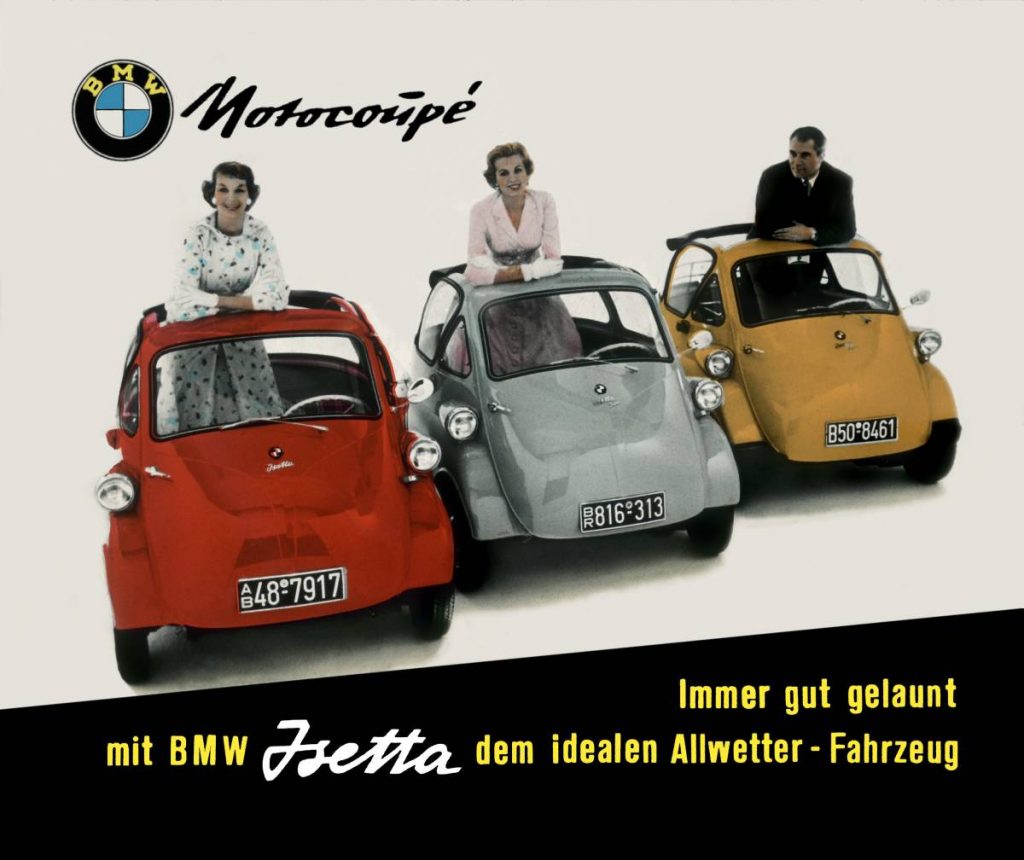
Advertising motif: BMW Isetta, 1955 Source: BMW Group
The history of the BMW Isetta
After the resumption of motorcycle production in 1948 and the restart of automobile production in 1952, the difficult years for BMW were far from over. Although the production of the hard-to-sell luxury cars of the 501 and 502 series restored the brand name to its former glory, it did not improve the company’s difficult financial situation. BMW was once again building automobiles for the “cream of society”, but even the good motorcycle business could hardly finance this luxury. The time was ripe for a small car – the BMW Isetta.
"Have fun – save costs – drive a BMW Isetta!"
BMW Group
Product slogan from 1955
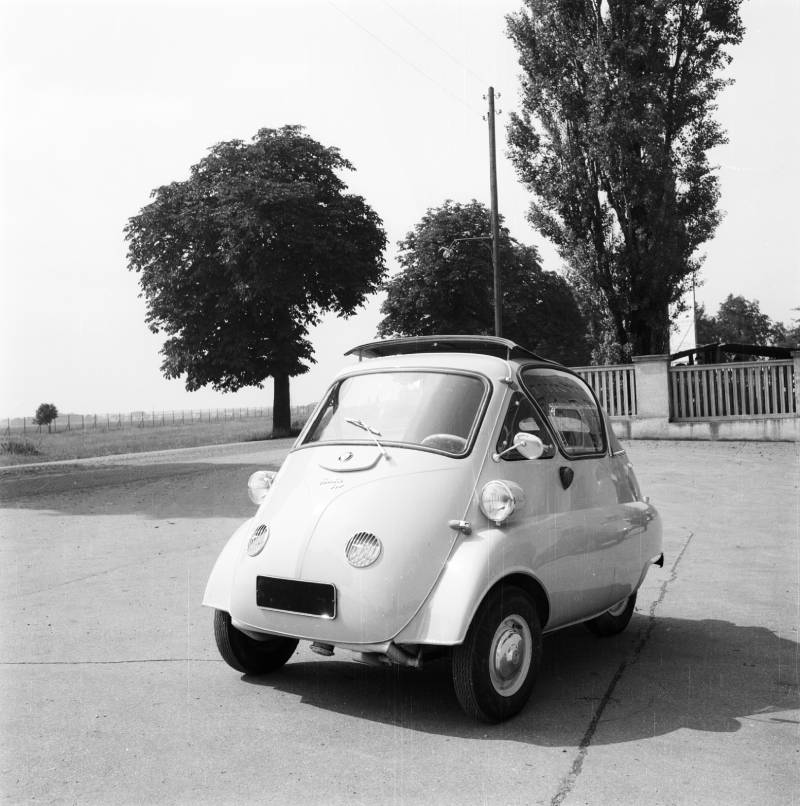
"Bubble Car" or "Cuddle Ball" (German: "Knutschkugel") – driver and front passenger sit on a continuous bench. Source: BMW Group
The heyday of scooters and microcars
Around 1954, it became clear that BMW would not survive without a model that was easy to sell and inexpensive to produce. However, a completely new development of an automobile would no longer have been financially viable for the company. It was the heyday of scooters and microcars, and so the search was on for a high-quality small vehicle that BMW could build under license. They soon came across an egg-shaped mobile with a front door from the Milan-based company Iso. After careful examination, this very original and practical “Isetta” was found to be suitable for rolling off the production line as a BMW small car after certain modifications. The license agreement was signed.
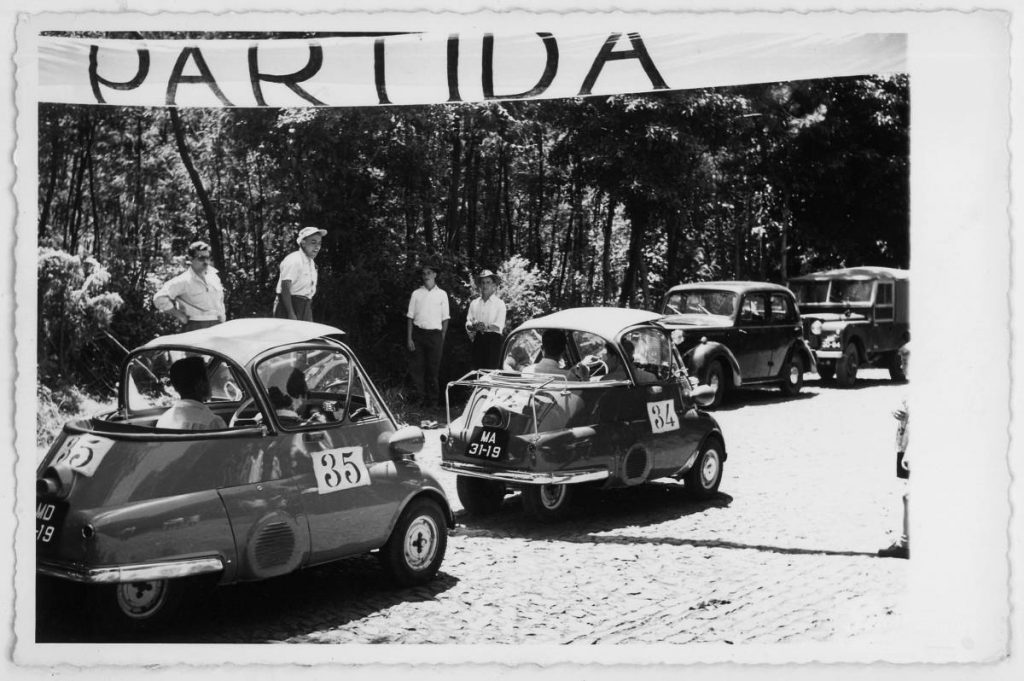
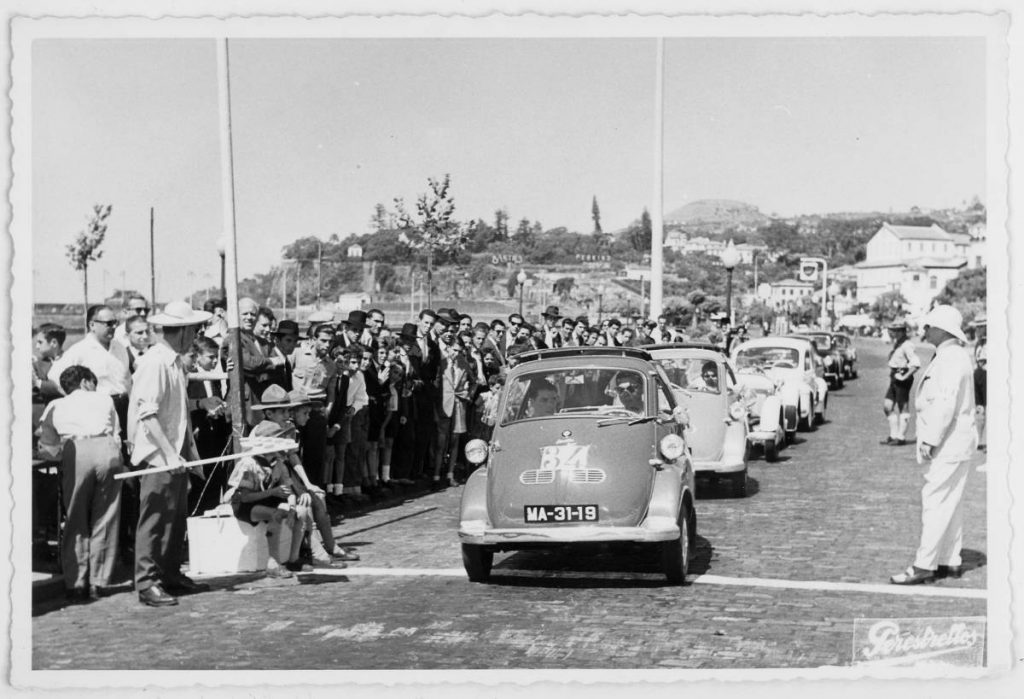
The little balls were very popular at rallies. Source: BMW Group
A motorcycle engine for the Isetta
Instead of the two-stroke engine, the Isetta was fitted with the single-cylinder four-stroke engine from the R 25 motorcycle; production started in spring 1955 with 250 cc and 12 hp, followed at the end of the year by the 1 hp more powerful Isetta 300. It quickly became clear that BMW had hit the bull’s eye with this unusual model. Well over 10,000 Isettas were sold in the very first year of production.
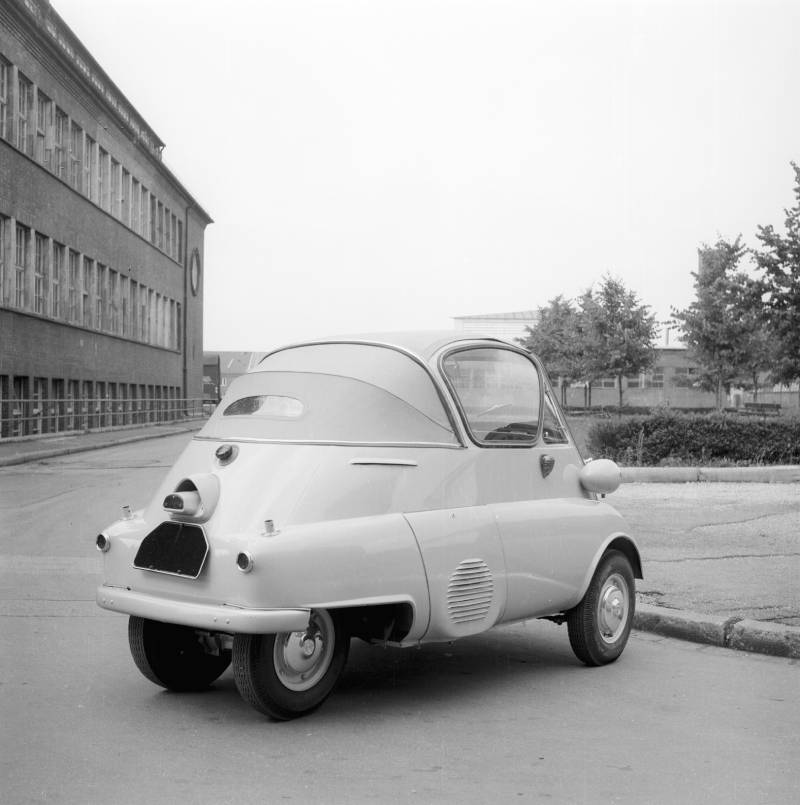
The BMW Isetta was also known as the "Knutschkugel". Source: BMW Group
Special versions such as the Tropical Isetta
This first version of the Isetta 250 and 300 still largely corresponded externally to the original Italian model. In Munich, however, a different engine cover was used and, after an initial series with long headlight housings, a revised model with smaller housings was offered. There were already export variants with large bumpers and headlights for the USA and special versions such as the “Tropical Isetta” with additional ventilation openings in the front door, the Isetta Cabriolet with a soft top instead of the rear window, or the cargo Isetta with a tiny loading area.
Small but mighty: the BMW Isetta is a welcome sight at international rallies. Source: BMW Group
Export version of the Isetta
A revised Isetta with a modernized body appeared at the end of 1956. It bore the name BMW Isetta Export. The previous model was called the BMW Isetta Standard and was offered at a lower price for a few more months. The Export Isetta 250 or 300 produced from November 1956 was very different from the previous version. Similar to a coupé, the roofline was now continuous and numerous details had given way to more modern solutions. Like the previous model, the Isetta Export could also be ordered in various special versions and country versions.
Advertising motif: BMW Isetta, 1955 Source: BMW Group
BMW Isetta – Brand embossing
BMW produced a total of 161,728 Isettas worldwide between 1955 and 1962. The BMW Isetta gained a high degree of popularity for the brand and shaped an entire era in automotive history.
Technical data: BMW Isetta
Performance
Motor type
Maximum speed
Displacement
Quantity
Performance
originally 12 hp at 5800 rpm
Motor type
1-cylinder
Maximum speed
85 km/h
Displacement
247 ccm
Quantity
From 1955 to 1962, BMW produced a total of 161,728 Isettes worldwide.
Due to extensive renovation measures, BMW Welt will be closed for 5 weeks from January 7, 2025! This closure(until February 10, 2025) only affects the exhibitions in BMW Welt. The exhibitions in the BMW Museum are not affected! Further events worth seeing in 2025 can be found in our event calendar.
To provide the best experiences, we use technologies like cookies to store and/or access device information. Consenting to these technologies will allow us to process data such as browsing behavior or unique IDs on this site. Not consenting or withdrawing consent, may adversely affect certain features and functions.
Functional
Always active
The technical storage or access is strictly necessary for the legitimate purpose of enabling the use of a specific service explicitly requested by the subscriber or user, or for the sole purpose of carrying out the transmission of a communication over an electronic communications network.
Preferences
The technical storage or access is necessary for the legitimate purpose of storing preferences that are not requested by the subscriber or user.
Statistics
The technical storage or access that is used exclusively for statistical purposes.The technical storage or access that is used exclusively for anonymous statistical purposes. Without a subpoena, voluntary compliance on the part of your Internet Service Provider, or additional records from a third party, information stored or retrieved for this purpose alone cannot usually be used to identify you.
Marketing
The technical storage or access is required to create user profiles to send advertising, or to track the user on a website or across several websites for similar marketing purposes.